Why Korean Restaurants Use Scissors to Cut Your Food
Published on June 26, 2026
For many first-time visitors to South Korea, dining out offers a series of small, delightful surprises. The metal cups for cold water, the hidden drawer under the table containing spoons and chopsticks, and the call button that summons a server in seconds.
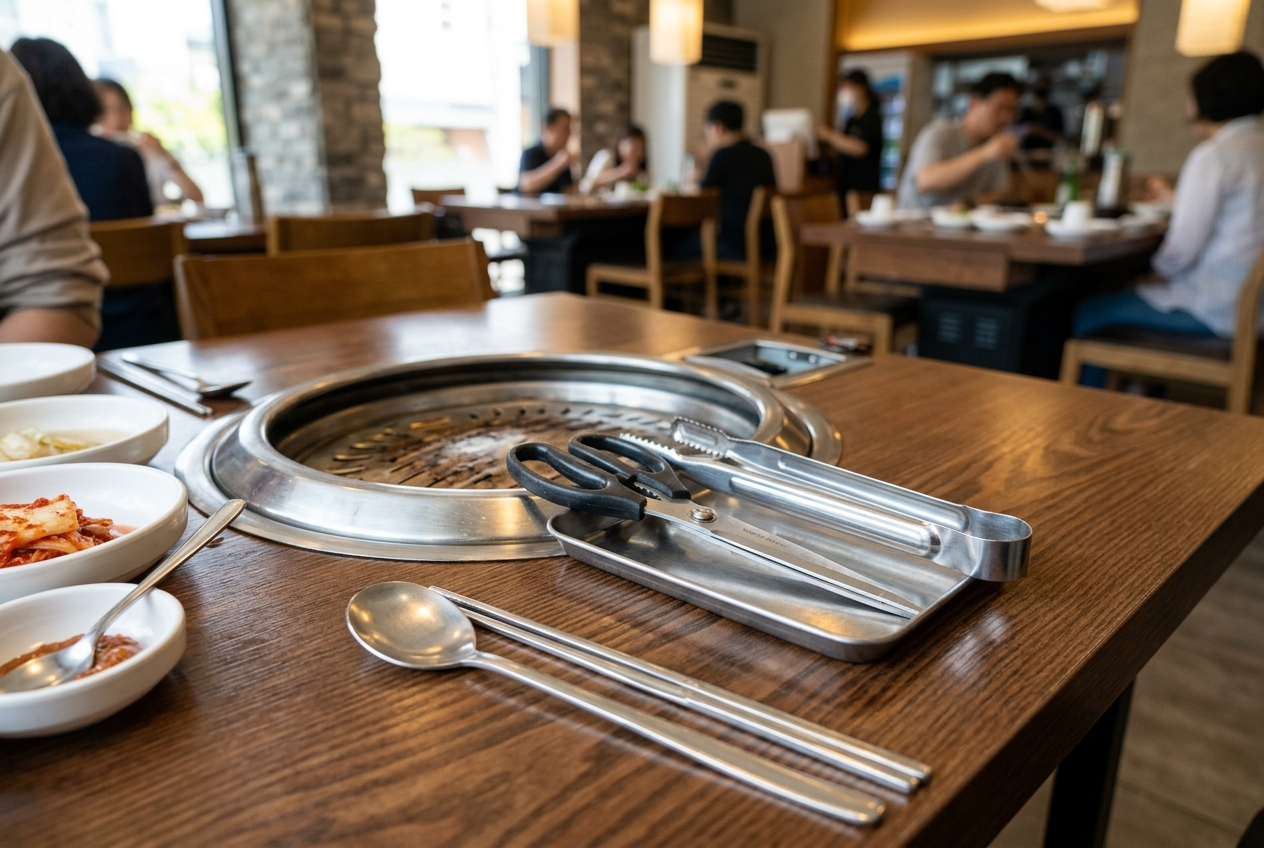
But there is one dining tool that often causes a double-take: a pair of heavy-duty metal kitchen shears resting alongside the cutlery.
In Western dining, scissors belong in the kitchen drawer or the craft room, never at the dinner table. Yet in South Korea, scissors are an essential, active part of the meal, used to cut everything from sizzling strips of pork belly to long, springy noodles directly in the bowl.
This practice is not a lack of dining etiquette. Instead, it is a masterclass in efficiency, safety, and culinary science.
The Grill is the Plate: Protecting the Cookware
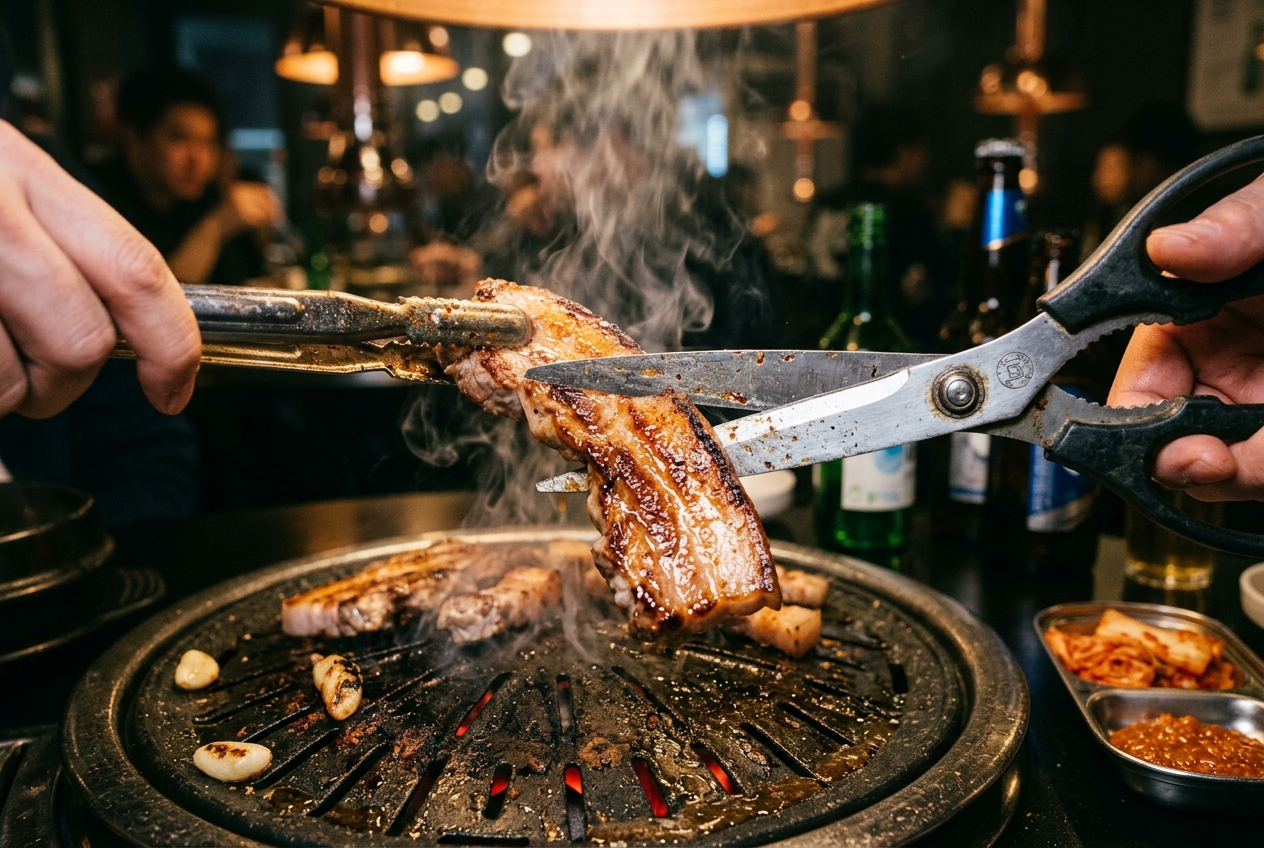
To understand why scissors are used, one must look at how Korean food is served. In Korean barbecue (K-BBQ), the cooking happens right in front of the diners on a hot metal grill built into the table. The "grill is the plate."
If you were to use a standard carving knife to slice meat as it cooks, you would face several immediate problems:
* Damaging the Grill: Pressing a sharp knife against a hot metal grill or stone plate would scratch the non-stick coating or dull the blade instantly.
* Safety Hazards: Attempting to press down and cut thick pork belly on a hot, unstable surface is a recipe for burns and slips.
* Awkward Angles: Cutting flat on a hot grill while sitting down is ergonomically difficult.
Scissors solve all these issues. By lifting the meat with a pair of tongs, the server or diner can cut the meat suspended in mid-air. The blades never touch the grill, preserving both the cookware and the table's safety.
Shearing Force vs. Sawing Motion
Beyond safety, there is a physical reason why kitchen shears are superior for table-side preparation. A knife cuts by applying downward pressure combined with a friction-based "sawing" motion. When meat is only partially cooked, it is elastic and soft. Trying to slice it with a knife on a grill often results in tearing, crushing, and squeezing out the precious juices.
Scissors, on the other hand, utilize shearing force. Two sharp blades slide past each other, clamping the food from both sides and slicing it instantly. This mechanism cuts cleanly through tough fibers, fat layers, and even bone cartilage without crushing the structure of the meat. The result is clean, bite-sized pieces that retain their moisture and cook evenly.
The Naengmyeon Challenge: Taming the Noodles
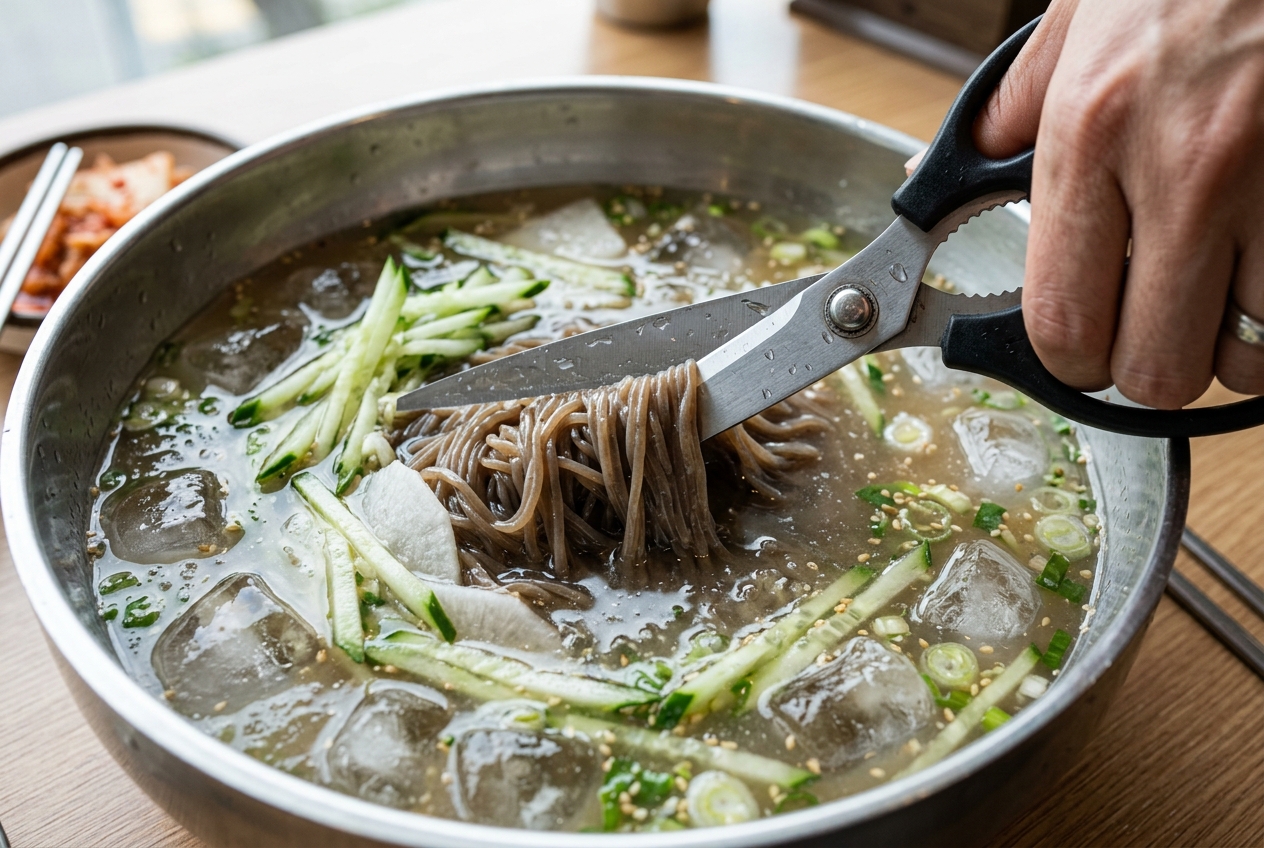
Meat isn’t the only thing that gets the scissor treatment. If you order Naengmyeon (Korean cold buckwheat noodles), the server will often ask, "Should I cut the noodles for you?" before snipping them in a cross pattern (+) directly in your bowl.
Traditional Korean noodles, especially buckwheat or sweet potato starch varieties, are incredibly long and chewy. Unlike Italian pasta, which is designed to be twirled around a fork, Korean noodles are eaten with chopsticks and are highly elastic.
Leaving them uncut presents a genuine eating challenge and a minor choking hazard, particularly because the dish is served ice-cold, which makes the starches firmer. A quick double-snip with table shears breaks the long strands into manageable lengths, making it easy to scoop up a perfect bite with chopsticks.
The Roots of Table Shears and "Palli-Palli" Culture
The ubiquity of scissors is closely tied to Korea's post-war industrialization and its famous palli-palli (hurry-hurry) culture. In the 1970s, as eating-out culture began to settle in South Korea, shears were introduced to the dining table. Initially, this practice started with cutting long, chewy noodles like naengmyeon to make them easier to eat. Over time, as table-grill BBQ dining grew popular, this convenient tool naturally transitioned to cutting meats directly at the grill, turning dining into an interactive, fast-paced group activity.
Furthermore, South Korea has a highly developed manufacturing sector for kitchenware. Companies like Obok Scissors designed heavy-duty, rust-resistant, stainless steel shears specifically for food service. These shears are balanced to cut through raw meat easily and withstand hundreds of dishwasher cycles daily, becoming an iconic export found in K-BBQ spots worldwide.
Frequently Asked Questions
Q: Is it sanitary to use scissors on food at the table?
Answer: Yes, absolutely. The scissors used at Korean tables are dedicated, high-grade stainless steel kitchen shears. They are treated exactly like spoons, chopsticks, and plates—washed, sanitized, and sterilized at high temperatures between uses. They are never used for opening packages or cutting non-food items.
Q: Why doesn't the chef just cut the meat in the kitchen first?
Answer: Slicing meat before cooking exposes more surface area to air, causing it to dry out and lose flavor. Grilling large pieces whole locks in the juices. Once the outer layer is seared, cutting it table-side ensures that the inside cooks rapidly and stays tender.
Q: Can I decline having my noodles cut?
Answer: Yes. If you prefer long noodles—which traditionally symbolize longevity in East Asian culture—you can simply say, "Gawi an jusyeodo dwaeyo" (You don’t need to give me scissors) or gently wave them off when the server offers to cut the noodles.